Protecting Your Home or Business with Expert Roofing You Can Trust."
Protecting Your Home or Business with Expert Roofing You Can Trust."
Roof cleaning is one of the most overlooked maintenance tasks for New Jersey homeowners, yet it directly impacts your roof's lifespan, your home's curb appeal, and your insurance coverage. According to the Asphalt Roofing Manufacturers Association (ARMA), moss can cause the leading edges of shingles to lift or curl, increasing the risk of shingle blow-off during wind events. In severe cases, moss build-up can cause lateral water movement resulting in moisture damage to the roof deck or may even cause leaks. This guide covers the ARMA-approved soft wash method, NJ-specific cost data, insurance implications, and how professional cleaning prevents $15,000 replacement bills.
Sources: WiseGuyReports, 2026, Thumbtack, 2025, HomeAdvisor, 2026
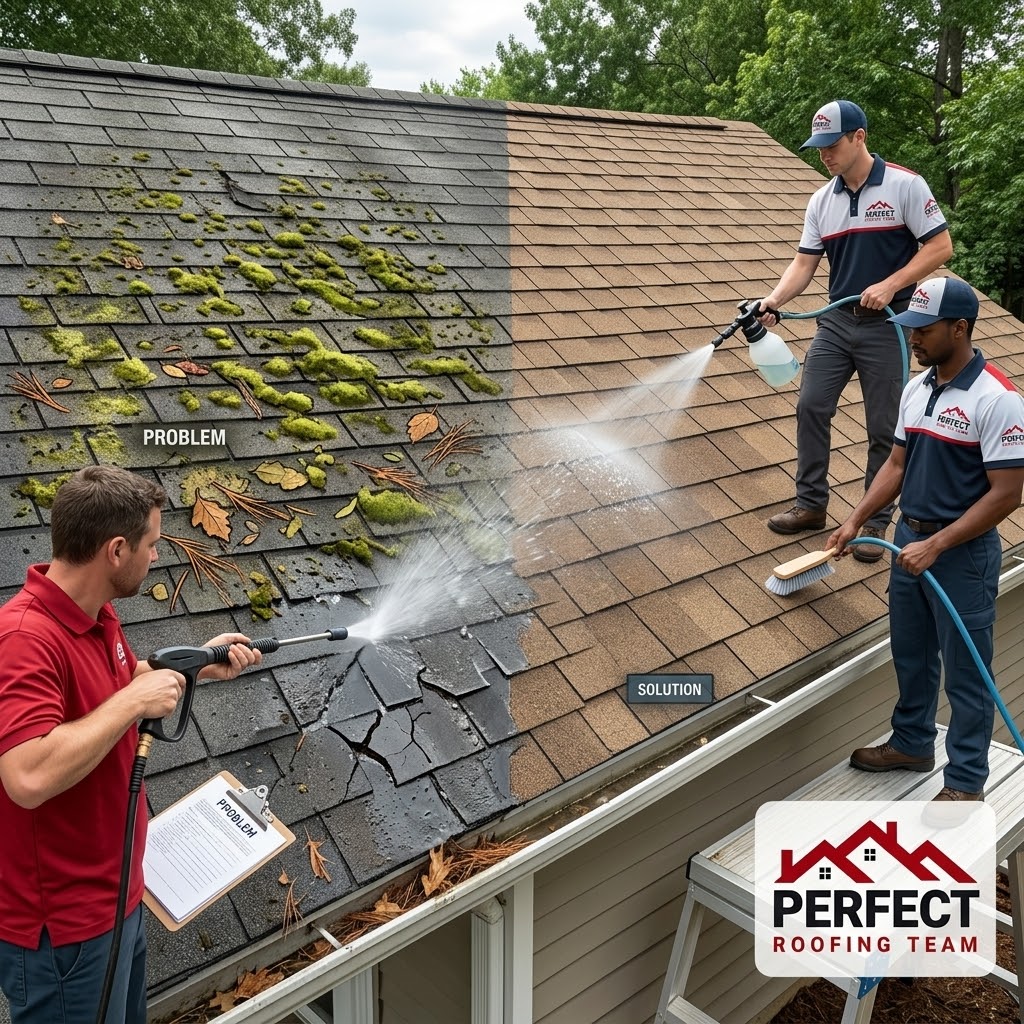
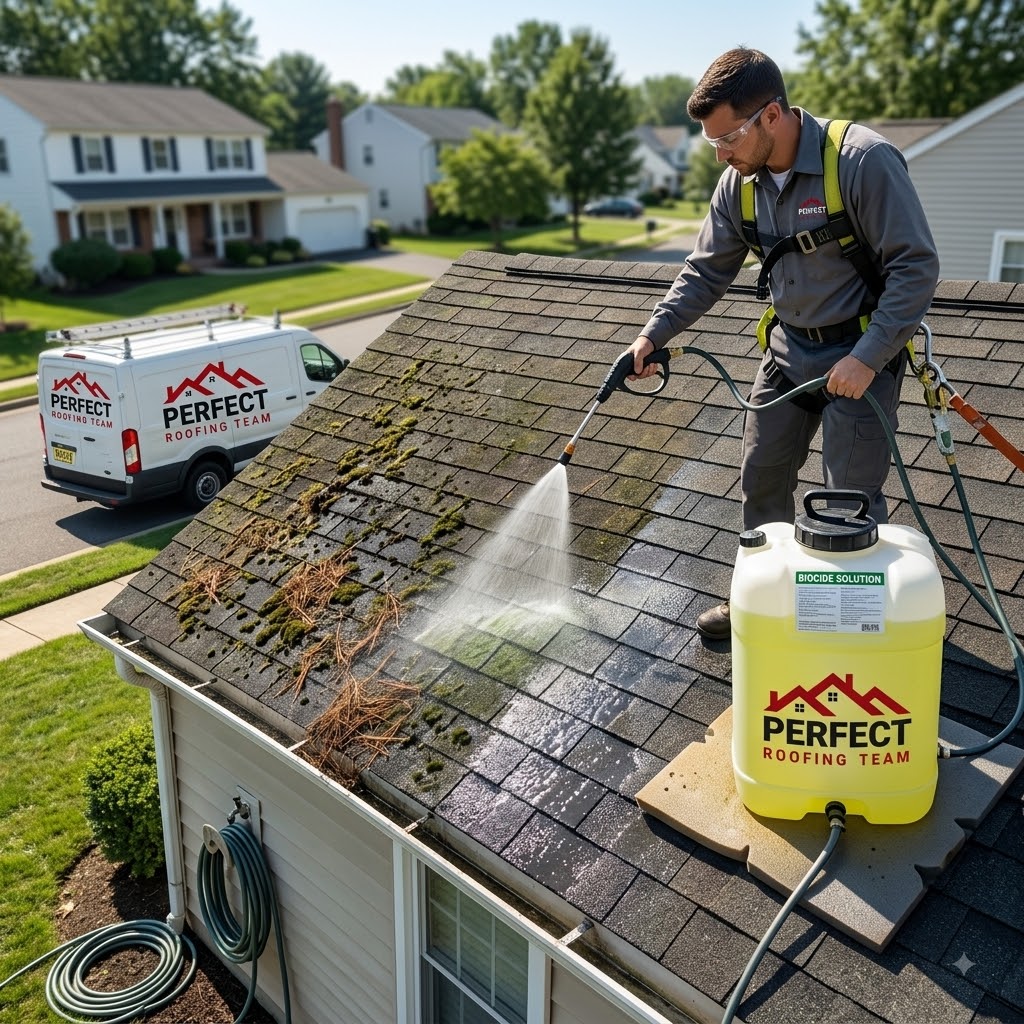
Professional roof cleaning by Perfect Roofing Team utilizes a gentle, damage-free soft wash method to safely eliminate destructive moss, algae, and dark stains. Unlike high-pressure washing, which can strip protective shingle granules, our specialized low-pressure treatment preserves your roof's structural integrity while extending its overall lifespan across New Jersey's diverse seasonal climates. By targeting the root cause of organic growth, we prevent premature shingle decay and maintain your home's curb value without risking water intrusion.
New Jersey's climate creates ideal conditions for roof contaminants. Coastal humidity in Monmouth and Ocean counties, dense tree cover in Sussex and Passaic counties, and freeze-thaw cycles in Bergen and Hudson counties all accelerate moss and algae accumulation. According to ARMA, the black discoloration and streaks visible on many roofs across the United States and Canada are algae — specifically Gloeocapsa magma, a cyanobacterium that feeds on the limestone filler in modern asphalt shingles. By the time the algae are visible, ARMA notes, it has been present for several months or longer.
"Moss can be detrimental to asphalt shingle performance. Moss can cause the leading edges of the shingles to lift or curl, which increases the risk of shingle blow-off during wind events. In severe cases, moss build-up can cause lateral water movement resulting in moisture damage to the roof deck or may even cause leaks."
— Asphalt Roofing Manufacturers Association (ARMA), Technical Bulletin, 2012
For comprehensive care, we recommend pairing this service with our professional roof inspection to identify any underlying wear before cleaning begins. The National Roofing Contractors Association (NRCA) recommends homeowners inspect their roof systems at least twice per year, preferably in the spring and fall. This biannual cadence reflects the thermal and moisture loading patterns most asphalt shingle roofs experience across temperate US climates — and New Jersey's hot, humid summers and cold, snowy winters place roofs under significant stress.
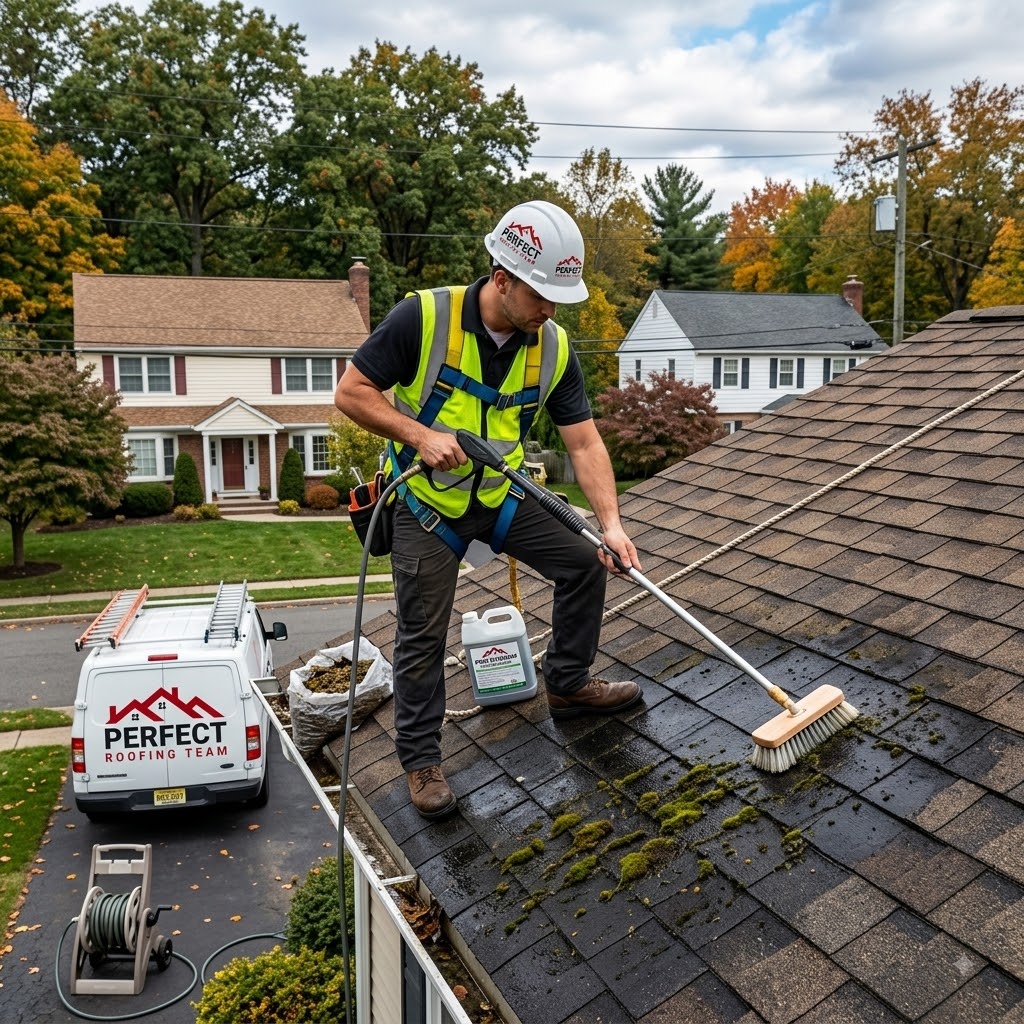
Many NJ homeowners make the mistake of waiting until visible leaks appear before addressing roof contamination. By that point, moisture may have already compromised the roof deck, insulation, and interior drywall. A proactive soft wash treatment every 2 to 5 years — combined with biannual inspections — catches problems before they require structural repairs. Regular roof maintenance is not an expense; it is insurance against a $15,000 replacement project.
Key Point: Moss and algae are not cosmetic issues — they are structural threats that trap moisture, lift shingles, and create pathways for water damage. Addressing them early with ARMA-approved soft washing prevents costly repairs.
Not all roof cleaning is equal. The method your contractor chooses determines whether your shingles survive the process intact or suffer accelerated aging. The Asphalt Roofing Manufacturers Association — the principal US trade body representing manufacturers of asphalt roofing products including GAF, Owens Corning, CertainTeed, and Atlas — has issued explicit cleaning guidance that manufacturers incorporate into warranty terms.
ARMA specifies that the most effective method of cleaning algae and moss from a roof is with a 50:50 mix of laundry strength liquid chlorine bleach and water. The solution is applied with a sprayer, allowed to dwell for 15 to 20 minutes, and then rinsed thoroughly with low-pressure water. The pressure must remain under 100 PSI — roughly equivalent to a garden hose. This is the soft wash standard.
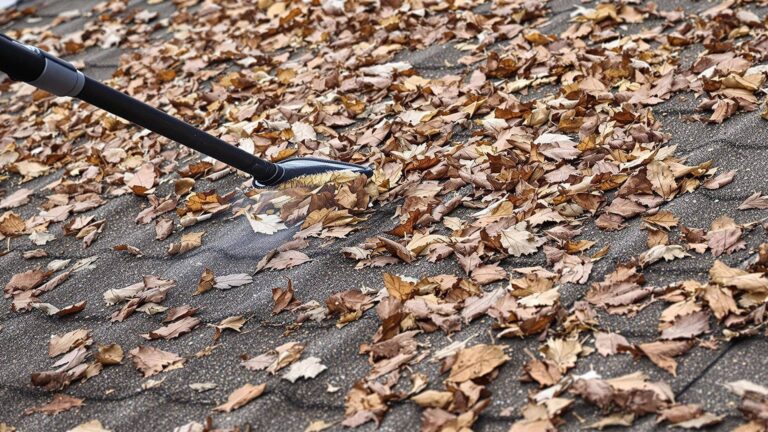
Hiring a pressure washing company to blast the roof with 1,500–4,000 PSI mechanical force. This strips the ceramic granules that shield shingles from UV radiation, voids manufacturer warranties, and forces water under shingles where it causes hidden rot. ARMA explicitly warns: "Never use a pressure washer to clean an asphalt shingle roof as this will cause granule loss and very likely premature failure of the roof system."
Soft washing works through chemistry, not force. A surfactant-based solution penetrates the algae, moss, and Gloeocapsa magma at the cellular level, killing the organism. The dead growth weathers away naturally over 2 to 4 weeks. Because the root system is destroyed rather than merely knocked off, soft wash results last 2 to 5 years — compared to months for pressure washing, which leaves live spores behind to regrow quickly.
Key Point: Soft wash is the only method approved by major shingle manufacturers. Pressure washing voids warranties and causes granule loss. Always verify your contractor uses ARMA-spec equipment rated under 100 PSI.
Your roof represents 10% to 15% of your home's value. In New Jersey, where the average roof replacement runs $15,000 and premium installations in Bergen and Hudson counties reach $28,000, protecting that asset is a financial imperative. But the risk extends beyond replacement costs — it now includes insurance coverage.
| Risk Factor | Neglected Roof | Professionally Cleaned Roof |
|---|---|---|
| Shingle lifespan | Granule loss, curling, premature failure | Granules intact, warranty preserved |
| Moisture damage | Moss traps water → deck rot, interior leaks | Dry surface, proper drainage maintained |
| Insurance status | Claims denied for "neglect"; policy cancellation risk | Documented maintenance supports claims |
| Curb appeal / resale | Black streaks, green patches reduce buyer interest | Near-original appearance, faster sale |
Insurance companies are increasingly aggressive about roof maintenance. Insurers including Liberty Mutual, Safeco, Travelers, and State Farm now use satellite and drone imagery to identify roofs with moss, algae, or debris. These images often lack clarity, leading to disputes when homeowners prove their roofs are undamaged — but the initial flagging can trigger premium increases, coverage exclusions, or non-renewal demands.
"We're seeing more insurance companies require annual roof inspections and maintenance records. Homeowners who can't provide documentation of regular professional roof cleaning and maintenance are finding their claims denied, especially for water damage that could have been prevented."
— Paul Koblik, Owner, All Seasons Cleaning Services (Portland, OR), 2025
Most homeowners policies contain language requiring the homeowner to maintain the roof. Neglecting moss or algae can be deemed negligence, voiding claims for water damage or mold. In New Jersey's competitive insurance market, where coastal and flood policies are already under pressure, a moss-flagged roof can force you into high-risk pools with significantly higher premiums.
New Jersey homeowners routinely underestimate the return on roof cleaning because they compare it to the wrong baseline. The question is not "How much does cleaning cost?" but "How much does cleaning save compared to premature replacement?"
According to Thumbtack's 2025 national data, the average roof cleaning costs $514, with a typical range of $365 to $723. In New Jersey specifically, most residential roof cleanings run $400 to $900 depending on roof size, pitch, and contamination level. By contrast, HomeAdvisor's 2026 data shows the average roof replacement in New Jersey costs roughly $15,000, with Bergen County installations ranging from $18,000 to $26,000 and Hudson County from $19,000 to $28,000.
The math becomes even more compelling when you factor in NRCA maintenance data. While the association's specific 21-year vs 13-year comparison applies to commercial low-slope systems, the underlying principle holds for residential roofs: documented, scheduled maintenance consistently extends useful life and reduces total cost of ownership. A roof cleaned every 3 years and inspected twice annually will outlast a neglected roof by a significant margin — often 5 to 10 years.
Perfect Roofing Team uses gentle soft-washing techniques that safely remove algae and moss, protecting your shingles and potentially saving thousands of dollars in avoidable repairs. Regular maintenance also preserves your home's curb appeal and ensures your homeowner's insurance policy remains compliant, as many insurers require roofs to be free of destructive organic growth. To ensure your roof is in optimal condition, consider scheduling a roof maintenance assessment alongside your cleaning.
Here is what NJ homeowners should expect from a professional, ARMA-compliant soft wash service. Our process follows the technical specifications published by the Asphalt Roofing Manufacturers Association and incorporates OSHA fall protection standards for all work at or above 6 feet.
Step 1 — Ground Inspection: We walk the perimeter to identify roof pitch, substrate type, growth species (algae, moss, lichen), gutter condition, and vegetation that requires pre-wetting protection. We do not quote from satellite imagery alone.
Step 2 — Protection and Pre-Wet: All shrubs, grass, and landscaping within the runoff zone are saturated with water before chemical application. Saturated plants are more resistant to dilute cleaning solution in runoff. Gutters are cleared to prevent chemical-laden overflow.
Step 3 — ARMA-Spec Solution Application: We apply a low-concentration sodium hypochlorite and surfactant solution at under 100 PSI — about garden-hose strength. The solution is applied bottom-to-top with 6–8 inch overlap passes. Dwell time is 15 to 20 minutes for standard residential roofs; heavy lichen may require extended dwell up to 20 minutes.
Step 4 — Low-Pressure Rinse: Starting at the ridge and working down, we rinse with low-pressure water. Simultaneously, all plant material is flushed with neutralizer solution. We never let the cleaning solution dry completely on the surface, as this prevents complete rinsing.
Step 5 — Documentation: We photograph the completed work from the ground, check for even rinsing and gutter condition, and provide you with dated maintenance records. This documentation is what insurance companies want to see when they ask for proof of regular roof care. Most organic growth lightens within 24 to 72 hours as residual solution continues working.
When you notice black streaks, green moss, or lichen colonies; after severe weather events with winds exceeding 50 mph; or if your shingles are within 10 years of their rated lifespan, call (862) 238-6353. Our licensed, insured team serves Bergen, Hudson, Passaic, Sussex, and all surrounding NJ counties with 24/7 emergency response.
Global roof cleaning services market valued at $3.34 billion in 2025 — projected to reach $4.5 billion by 2035 at a 3.0% CAGR, driven by aging housing stock and consumer awareness of maintenance benefits. (WiseGuyReports, 2026)
North America holds the majority market share at $1.1 billion in 2024 — forecasted to reach $1.4 billion in 2035, benefiting from robust demand for roof maintenance services spurred by urbanization and stringent building codes. (WiseGuyReports, 2026)
44% of US single-family homes are 30+ years old — meaning millions of roofs are at or beyond mid-life, where moss and algae acceleration is most damaging. (RoofLink, 2025)
92% of homeowners rank the roof as a "top priority" — yet many still defer cleaning until visible damage appears. (RoofLink, 2025)
85% of roofing contractors report skilled labor shortages — according to the NRCA 2024 Labor Survey, up from 82% in 2022. Hiring a established, fully staffed company like Perfect Roofing Team ensures your project is not delayed by staffing gaps. (RoofLink citing NRCA, 2024)
Roofing remains among the top 5 most hazardous jobs — with fatality rates near 60 deaths per 100,000 workers in 2024 per BLS data. DIY roof cleaning is dangerous; professional crews carry OSHA-compliant fall protection and liability insurance. (RoofLink citing BLS, 2024)
"The most effective method of cleaning algae and moss from a roof is with a 50:50 mix of laundry strength liquid chlorine bleach and water. Apply with a sprayer and allow the solution to dwell on the roof surface for 15 to 20 minutes, and then rinse thoroughly with low pressure water. Never use a pressure washer to clean an asphalt shingle roof as this will cause granule loss and very likely premature failure of the roof system."
— Asphalt Roofing Manufacturers Association (ARMA), Technical Bulletin, 2012
"Unlike algae, moss can cause the leading edges of shingles to lift or curl, which increases the risk of shingle blow-off during wind events. In severe cases, moss build-up can cause lateral water movement resulting in moisture damage to the roof deck or may even cause leaks."
— Asphalt Roofing Manufacturers Association (ARMA), Algae & Moss Prevention Guide, 2012
"We're seeing more insurance companies require annual roof inspections and maintenance records. Homeowners who can't provide documentation of regular professional roof cleaning and maintenance are finding their claims denied, especially for water damage that could have been prevented."
— Paul Koblik, Owner, All Seasons Cleaning Services, 2025
Challenge: A 16-year-old architectural shingle roof in Paramus, Bergen County, showed heavy Gloeocapsa magma streaking on the north-facing slope and moss accumulation in valleys. The homeowner received a replacement quote of $22,000 from a competing contractor who claimed the roof was "too far gone." Insurance documentation showed no maintenance records for 8 years.
Solution: Perfect Roofing Team conducted a full roof inspection confirming structurally sound decking and 60%+ granule retention. We performed an ARMA-spec soft wash treatment with sodium hypochlorite surfactant solution at 80 PSI, followed by gutter clearing and debris removal. We applied a post-treatment neutralizer to landscaping and provided dated maintenance documentation.
Result: Black streaks lightened within 72 hours; moss dried and weathered away over 3 weeks. The roof's appearance returned to near-original color. The homeowner avoided a $22,000 replacement, preserved the manufacturer's remaining warranty, and now has documented maintenance records for insurance compliance. Total investment: $650. Projected extension of service life: 5+ years.
Source: Perfect Roofing Team client data, 2025–2026. Results based on verified ARMA cleaning protocols and NJ market pricing from HomeAdvisor and Golden Hammer NJ cost guides.
Protect your shingles, your insurance coverage, and your home value with ARMA-approved soft washing from licensed NJ pros. Free inspection and written estimate.
→ Schedule Your Free Roof Cleaning QuoteOr call us directly: (862) 238-6353 — Free inspection · 24/7 NJ service · Licensed & insured
The safest method is soft washing — a low-pressure application (under 100 PSI) of a diluted cleaning solution, as recommended by the Asphalt Roofing Manufacturers Association (ARMA). This kills moss, algae, and Gloeocapsa magma at the root without stripping protective granules or voiding shingle warranties from GAF, Owens Corning, and CertainTeed. Perfect Roofing Team uses this ARMA-spec method exclusively. Learn about our roof inspection process or read ARMA's official cleaning guidelines.
Most NJ roof cleanings run between $400 and $900 depending on roof size, pitch, and condition. Nationally, Thumbtack's 2025 data shows an average of $514, with a typical range of $365 to $723. By comparison, a full roof replacement in New Jersey averages roughly $15,000 according to HomeAdvisor's 2026 data — making cleaning one of the highest-ROI maintenance investments you can make. Request a free NJ quote.
Yes. Insurance companies increasingly view roof moss and algae as signs of neglect. Insurers including Liberty Mutual, Safeco, Travelers, and State Farm use drone or satellite imagery to identify high-risk properties. Moss-related water damage may be classified as a maintenance issue rather than a covered event, leading to denied claims or policy non-renewal. Regular professional cleaning provides the documentation insurers require. Read more about insurance and roof moss.
Pressure washing uses 1,500 to 4,000 PSI of mechanical force — roughly 20 to 40 times the pressure of ARMA-spec soft washing. This strips the ceramic granules that protect shingles from UV damage, forces water under shingles causing hidden rot, and voids most manufacturer warranties. ARMA explicitly warns against pressure washing because it causes granule loss and premature failure. View ARMA's technical bulletin.
The National Roofing Contractors Association (NRCA) recommends a minimum of two roof inspections per year — one in spring after winter stress, and one in fall before freeze-thaw cycling resumes. Homes with heavy tree cover, north-facing slopes, or visible algae streaking should also receive professional soft wash cleaning every 2 to 5 years. New Jersey's humid summers and snowy winters create conditions where moss accelerates quickly. Explore our maintenance plans.
Gloeocapsa magma is a cyanobacterium — not algae or mold — that causes the dark black streaks visible on asphalt shingles across humid climates. It feeds on the limestone filler used in modern shingles. According to ARMA, by the time the discoloration is visible, the organism has been present for several months or longer. While ARMA states there is no scientific evidence that algae itself damages shingles, the dark discoloration reduces reflectivity and the associated moss can cause structural harm. Read ARMA's algae guide.
No. Roof cleaning, gutter cleaning, and minor maintenance generally do not require a building permit in New Jersey. Permits are typically required only for full roof replacement, structural changes, re-roofing over existing shingles, or adding skylights. However, requirements vary by municipality — for example, some towns require permits for any roofing work while others exempt smaller homes. Always verify with your local building department if uncertain. See NJ permit requirements by town.
You should call a professional if you notice black streaks, green moss patches, or lichen growth; if your roof is steep or two stories; or if your shingles are within 10 years of their rated lifespan. Professional cleaners use ARMA-spec soft wash methods, carry proper insurance, and follow OSHA fall protection requirements for work at or above 6 feet. Roofing has fatality rates near 60 deaths per 100,000 workers — it is not a DIY project. Call (862) 238-6353 or request a free quote online.
✍ Written & reviewed by Perfect Roofing Team
Perfect Roofing Team — Licensed & insured NJ roofing contractor serving all 21 counties. This page was written and structured by the Perfect Roofing Team to reflect real, hands-on experience in roofing, storm damage, and emergency repair across New Jersey.
📍 380 Garibaldi Ave, Lodi, NJ 07644 · 📞 (862) 238-6353 · 🕒 Available 24/7/365 · 4+ years serving NJ homeowners & businesses
Last reviewed: July 2026
Perfect Roofing Team · perfectroofingteam.com · 380 Garibaldi Ave, Lodi, NJ 07644 · (862) 238-6353