Protecting Your Home or Business with Expert Roofing You Can Trust."
Protecting Your Home or Business with Expert Roofing You Can Trust."
For wind-specific structural damage, see our wind damage roof repair NJ page. For major storm impact, see storm damage roof repair NJ. For non-emergency roofing, visit the Perfect Roofing Team homepage.
When you need 24 hour emergency roof repair in NJ, you cannot wait for normal business hours. Perfect Roofing Team provides rapid, round-the-clock dispatch for active roof leaks, fallen tree limbs and urgent tarping across all 21 New Jersey counties — for both homes and businesses. Unlike general storm restoration or standard wind-damage repairs, our 24/7 emergency service is built for immediate leak mitigation to protect your property right now. As a licensed NJ home-improvement contractor (registration 13VH13554900) with management experienced in roofing for 15 years, we answer the emergency line day and night at (862) 238-6353; free estimates and upfront indicative pricing from $250 to $5,800+ follow an on-site assessment.

When your roof is damaged and water is entering your home, every minute matters. Here's exactly what to do, in priority order:
Roof emergency right now? Ongoing water intrusion can increase damage to insulation, ceilings, walls and belongings. Call (862) 238-6353.
Perfect Roofing Team understands that roof emergencies in New Jersey require immediate attention. A real person answers the emergency line 24/7, including nights, weekends and holidays. Dispatch begins immediately for active leaks and storm damage across all 21 NJ counties. Arrival and completion times vary by location, crew availability, weather, access and safety. Same-day service is available when circumstances allow, but it is not guaranteed.
Not every roofing issue requires an urgent call at 2am, but when these situations hit, fast action is critical to prevent secondary damage:
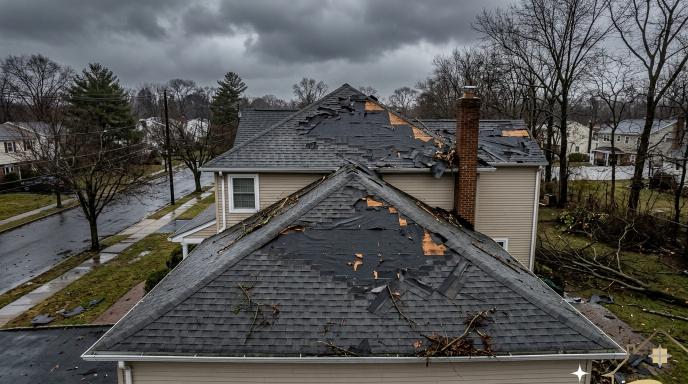
A nor'easter aftermath with multiple torn shingle sections and exposed decking qualifies as an urgent emergency. Water spreads into insulation, drywall, and framing within hours — turning a minor repair into a major restoration. After any storm with high winds or hail, request a professional assessment if you suspect roof damage that is not visible from the ground.
Perfect Roofing Team LLC has an indicative emergency-roofing range of $250 to $5,800+. This range is not a fixed quote or guaranteed final price. Pricing depends on the type and extent of damage, materials, roof access, safety conditions, temporary protection and the work required. The crew assesses the property on site and presents the final price before approved work begins. Price matching is available.
Pricing note: The $250–$5,800+ range is indicative. It is not a fixed online quote. Final pricing is determined on site after assessment and requires customer approval before work begins.
Coverage depends on the cause of damage, exclusions, deductibles and the individual policy. Perfect Roofing Team can provide a written estimate and company registration or insurance documentation on request. Your insurer determines coverage and claim decisions. Check your policy with the NJ Dept. of Banking & Insurance.
A real person answers the emergency line 24/7 and dispatch begins immediately. The actual arrival and repair time depends on your location, current crew availability, weather, roof access, safety, materials and the extent of damage.
Same-day service is available when circumstances allow, but no arrival or completion time is guaranteed before the location and conditions are assessed.
Perfect Roofing Team LLC provides 24/7 emergency roofing across all 21 New Jersey counties. A real person answers the emergency number day or night, dispatch begins immediately, and emergency service is available for residential and commercial properties. Emergency and temporary roof tarping is available when needed.
When you search for 24 hour emergency roof repair NJ, you'll find many contractors claiming 24/7 availability. Here's what actually separates a fast, professional response from a frustrating one:
Perfect Roofing Team responds to emergency calls across all 21 NJ counties. View all NJ service areas or call to start emergency dispatch:
A real person answers 24/7. Dispatch begins immediately across all 21 counties; timing depends on availability and conditions.
→ Explore Our Roofing ServicesOr call us directly: (862) 238-6353 — Free estimate · 24/7 NJ phone service
Perfect Roofing Team LLC has an indicative emergency-roofing range of $250 to $5,800+. The final price depends on the damage, materials, roof access, safety conditions and work required. The property is assessed on site and the price is presented before approved work begins. Price matching is available.
Active leaks, storm or wind damage, missing shingles, damaged flashing, hail damage and roof openings caused by branches can require urgent roofing help. If you suspect collapse or structural danger, leave the affected area and contact emergency services; Perfect Roofing Team does not perform structural repairs.
A real person answers 24/7 and dispatch starts immediately. Arrival and completion depend on location, availability, weather, access, safety and the work required. Same-day service is available when circumstances allow but is not guaranteed.
Yes — all 21 NJ counties, including Bergen, Essex, Morris, Passaic, Hudson, Union, Somerset, Middlesex, Monmouth, Ocean, Burlington, Camden, Mercer, Sussex, Warren, Hunterdon, Atlantic, Cape May, Cumberland, Salem, and Gloucester. Call (862) 238-6353 and we'll dispatch to your location.
In most cases yes, but use caution. If there's structural collapse risk or water near electrical systems, evacuate those rooms and turn off the circuit breaker for affected areas. Do not go on the roof yourself — wait for the professional crew, who will assess safety on arrival.
Insurance coverage depends on the cause of loss and your policy. Perfect Roofing Team can provide a written estimate and company registration or insurance documentation on request. Contact your insurer for coverage and claim decisions.
Yes. Perfect Roofing Team provides 24/7 emergency roof repair, active leak mitigation and temporary roof tarping for both residential and commercial properties across all 21 New Jersey counties. A real person answers the emergency line day and night at (862) 238-6353 and dispatch begins immediately.
Emergency roof tarping is often treated by insurers as reasonable temporary mitigation to limit further damage, but coverage depends on the cause of loss and your individual policy. Perfect Roofing Team can provide a written estimate and company registration or insurance documentation on request; your insurer determines coverage and claim decisions.

✍️ Written & reviewed by Perfect Roofing Team
Perfect Roofing Team is an insured New Jersey registered home-improvement contractor serving residential and commercial customers across all 21 counties. This page was reviewed by company management with 15 years of roofing experience.
📄 NJ HIC registration 13VH13554900 · 📍 380 Garibaldi Ave, Lodi, NJ 07644 · 📞 (862) 238-6353 · ✉️ info@perfectroofingteam.com
🕐 Emergency phone answered 24/7/365 · 4 years in business · Repair warranties up to 5 years and new-roof warranties up to 15 years, subject to the written project agreement.
Last reviewed September 10, 2026.