Protecting Your Home or Business with Expert Roofing You Can Trust."
Protecting Your Home or Business with Expert Roofing You Can Trust."
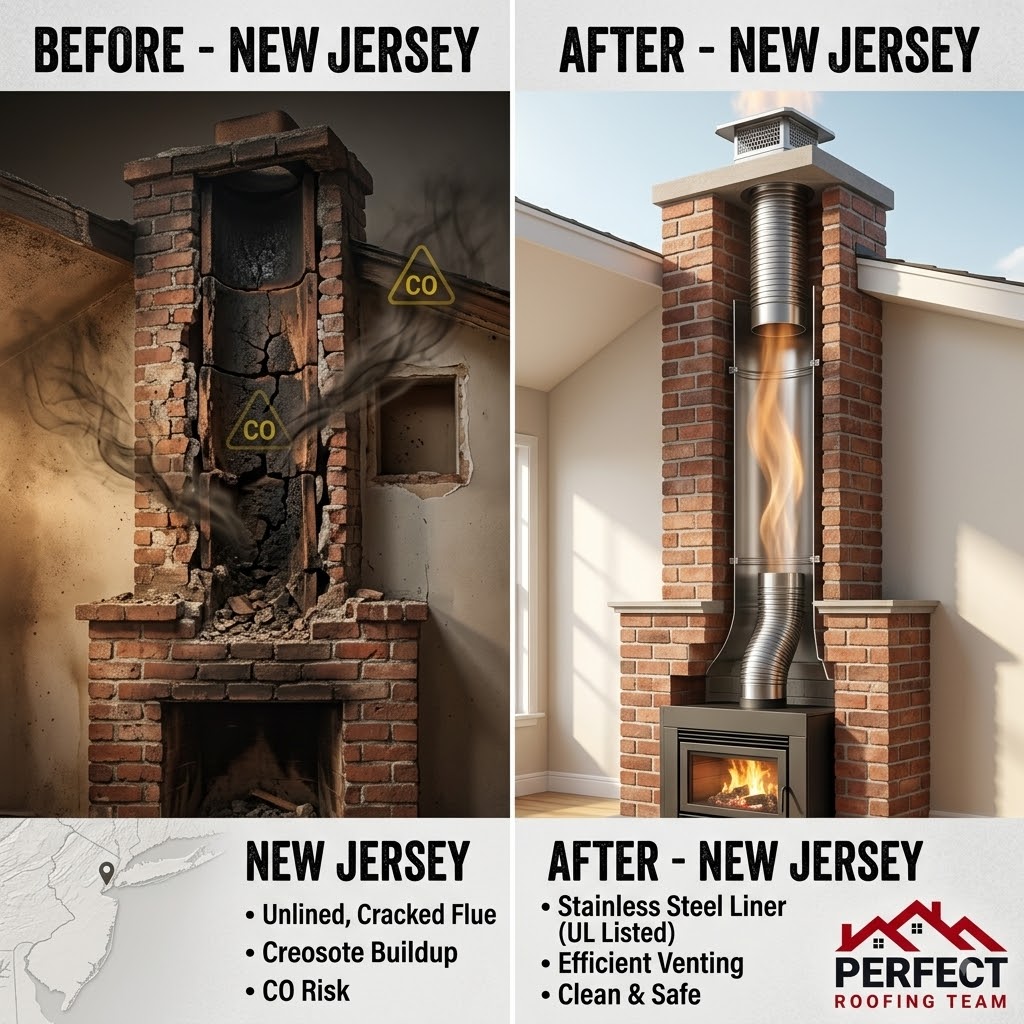
Chimney liners are crucial for the safety and efficiency of your chimney system. In 2024, local fire departments across the United States responded to an estimated 1,388,000 fires, causing 3,920 civilian deaths and $19 billion in direct property damage. According to the National Fire Protection Association (NFPA), heating equipment alone causes approximately 48,530 home fires annually, and chimneys account for a significant portion of these incidents. This guide covers everything NJ homeowners need to know about chimney liner types, code requirements, installation costs, and why professional relining is not optional—it is essential.
Sources: NFPA, 2024, HomeAdvisor, 2026, CSIA, 2024
A chimney liner is a clay, ceramic, or metal conduit installed inside a chimney, intended to contain combustion products, direct them to the outside atmosphere, and protect the chimney walls from heat and corrosion. According to the National Fire Protection Association (NFPA 211) and New Jersey building codes, every masonry chimney must have a flue liner to ensure safe operation. Without one, or if it is damaged, your chimney becomes a major fire hazard.
In New Jersey, the installation or replacement of chimney liners is subject to specific regulations. The New Jersey Department of Community Affairs mandates that all documentation related to the chimney liner—including material, size, calculations, and BTU/HR of all connected equipment—be submitted alongside the permit application. A construction permit is typically required from your local building department before any liner work begins.
"Heating equipment causes approximately 48,530 home fires annually. Chimneys and fireplaces account for a significant portion of heating-related fires, and improper installation and maintenance are leading factors."
— National Fire Protection Association, NFPA 211 Standard, 2024
If your NJ home was built before the 1950s, there is a strong chance your chimney is unlined or has a deteriorated clay tile liner. A professional camera inspection is the only way to confirm its condition. We recommend scheduling a Level 2 chimney inspection before every heating season.
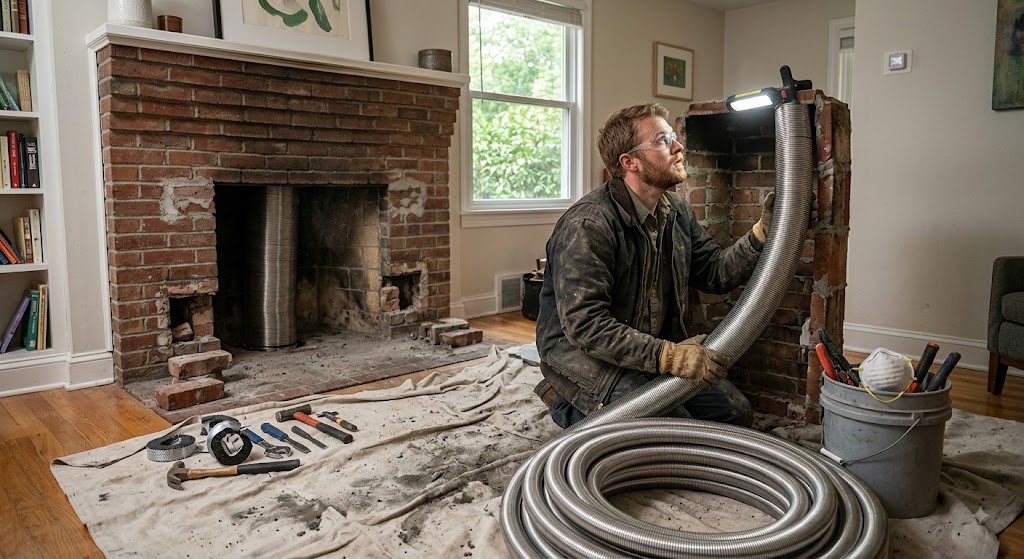
An unlined chimney can allow heat to transfer to nearby combustible framing in as little as three hours of continuous use, creating a severe fire risk that most homeowners never see coming until it is too late.
Key Point: If your NJ home was built before the 1950s, assume your chimney liner is compromised until a Level 2 camera inspection proves otherwise.
A properly installed chimney liner serves three critical safety functions. First, it prevents toxic carbon monoxide from leaking into living spaces. The CDC reports that more than 400 Americans die annually from unintentional CO poisoning not linked to fires, with over 14,000 hospitalized. A cracked or missing liner allows CO to seep through porous brick and mortar into bedrooms and attics.
Second, liners shield combustible home framing from extreme heat. The National Bureau of Standards determined in the 1940s that unlined chimneys are unsafe and a major fire hazard. Without a liner, heat can transfer to nearby wood framing, and creosote buildup can ignite at temperatures as low as 451°F.
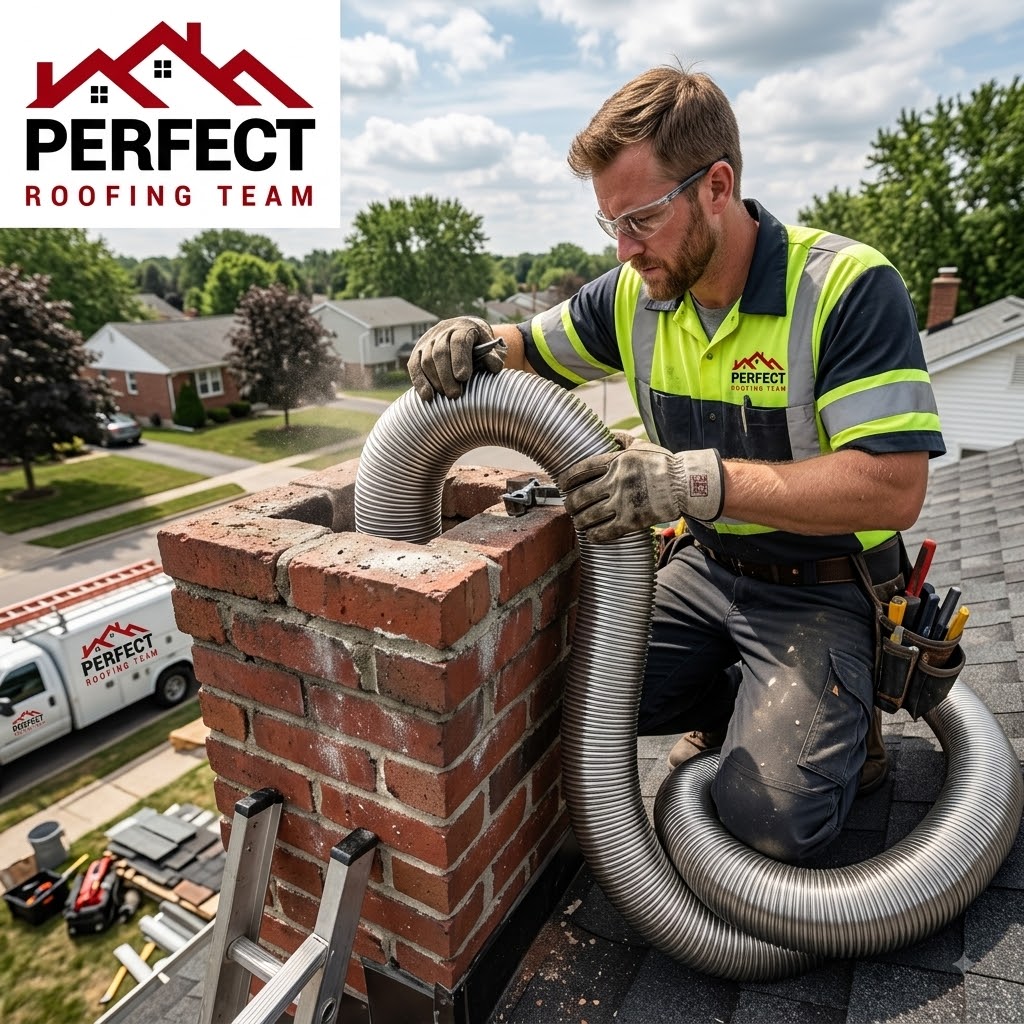
Many homeowners assume their chimney is fine because smoke still goes up the flue. By the time you notice smoke in the living room or a musty odor, your liner may already have dangerous cracks that allow carbon monoxide and creosote to leak into wall cavities. Annual inspection catches deterioration before it becomes lethal.
Third, liners protect masonry from corrosive acidic condensate. Modern high-efficiency gas appliances produce acidic moisture that eats away at mortar joints. A 316L stainless steel liner with proper insulation channels these byproducts safely outside while preserving your chimney's structural integrity for decades.
Key Point: A 316L stainless steel liner with insulation improves draft efficiency and reduces creosote buildup by up to 50% compared to an unlined flue.
Choosing the right chimney liner depends on your fuel type, chimney condition, and budget. Here is how the three primary options compare for New Jersey homes:
| Factor | Stainless Steel (316L) | Clay Tile | Cast-in-Place |
|---|---|---|---|
| Lifespan | 15–20+ years | 5–15 years | Up to 50 years |
| Best For | Wood, gas, oil relining | New construction only | Structural damage |
| Installation | Flexible or rigid sections | Requires demolition | Poured cement |
| Avg. Cost | $65 / sq ft | $10 / sq ft | $25 / sq ft |
| UL Listed | Yes (UL1777) | No | Varies by product |
Stainless steel chimney liners—specifically 316L grade—are the most popular choice for NJ relining projects. They resist corrosion, handle high temperatures up to 1,200°F continuously, and are listed to UL1777 zero clearance standards. Clay tile liners are inexpensive but crack easily under thermal shock from NJ freeze-thaw cycles and are nearly impossible to retrofit. Cast-in-place liners reinforce the entire chimney structure but require specialized equipment and carry the highest upfront cost.
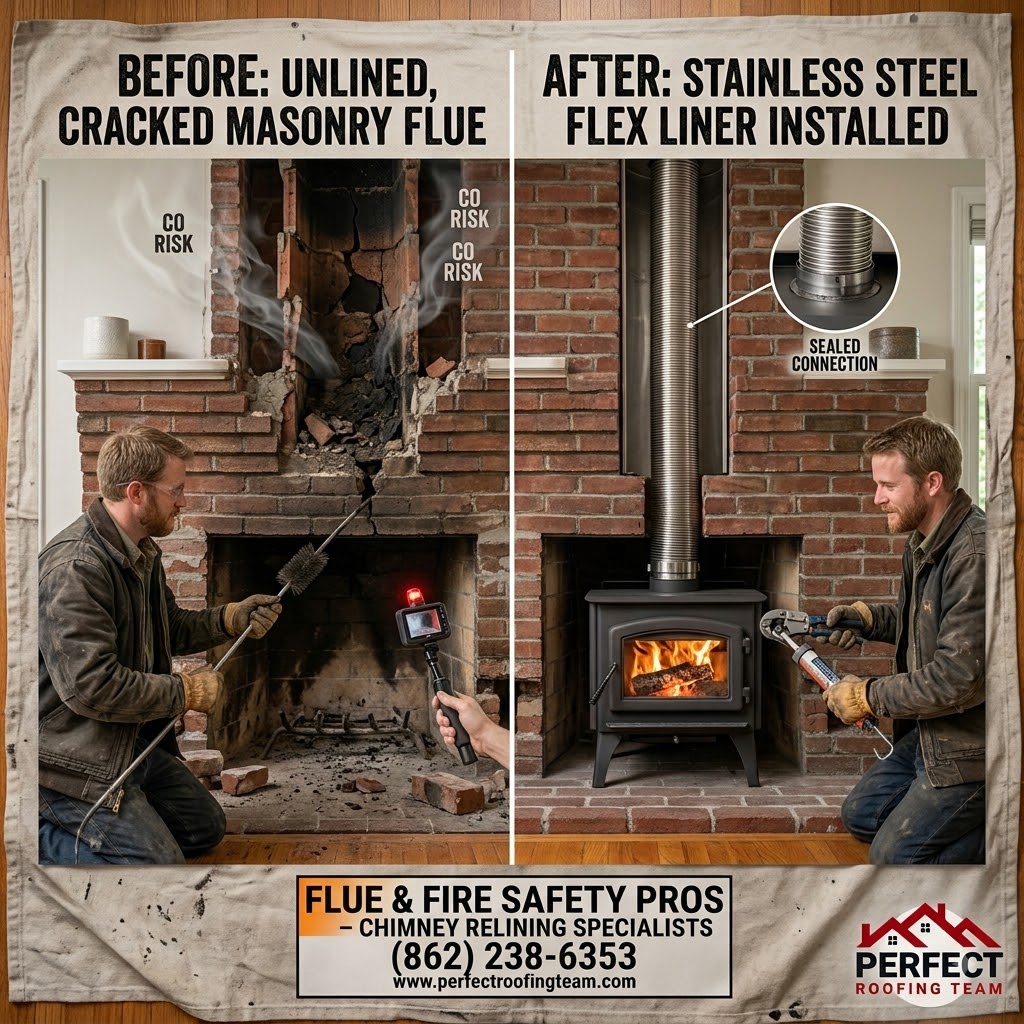
Professional chimney liner installation costs between $1,500 and $5,000, with most NJ homeowners spending around $2,500. Several factors influence your final price. Labor runs $400–$1,250 depending on roof height, pitch, and accessibility. Materials average $65 per square foot for 316L stainless steel. Permits and Level 2 inspections add $250–$450. If existing clay tiles must be removed or the crown is cracked, masonry repairs add $160–$750.
Our professional relining services utilize heavy-duty 316L stainless steel liners tested and approved to meet strict UL1777 zero clearance safety standards. Whether you need a new liner for a wood stove, fireplace, or furnace, our certified team ensures a secure fit that keeps your home safe.
Here is what NJ homeowners should expect when Perfect Roofing Team installs your chimney liner. First, our certified technicians conduct a Level 2 internal video inspection to assess flue condition and measure exact dimensions. Second, we file all NJ construction permit paperwork specifying 316L material, diameter, insulation, and total BTU/HR load per UCC-F370 guidelines.
Third, the liner is lowered through the chimney, connected to the appliance with a proper tee or top plate, and insulated with a foil-faced ceramic wool blanket to meet UL1777 zero clearance standards. A local code official inspects the installation, and we provide you with the approved permit, warranty documentation, and maintenance schedule. Updated for August 2026.
If your chimney has not been inspected in the last 12 months, schedule a Level 2 inspection before the next heating season. NJ winters are hard on masonry, and a compromised liner can turn a cozy fire into a life-threatening hazard without warning.
Step 1: Look for the warning signs. Smoke backing up into rooms, musty odors when the fireplace is not in use, white efflorescence on exterior brick, visible tile shards in the firebox, or a rusted damper all indicate liner failure.
Step 2: Contact a licensed NJ contractor who understands NFPA 211 and the NJ Uniform Construction Code. Ask for proof of insurance, a detailed written estimate, and whether they use UL1777-listed 316L stainless steel.
Step 3: Schedule the installation during mild weather. Spring and early fall are ideal because contractors have more availability, and you will not be without heat during a mid-winter emergency. Contact Perfect Roofing Team for a free, custom quote.
Expected results: A properly installed 316L liner improves draft efficiency, reduces creosote accumulation, and brings your chimney into full compliance with NJ code. In addition to liners, we provide expert chimney repair and maintenance services across New Jersey.
Call (862) 238-6353 for 24/7 emergency service. We serve all 21 NJ counties including Bergen, Hudson, Passaic, and Sussex.
1,388,000 fires — estimated in the US in 2024, causing $19 billion in damage and 3,920 civilian deaths. (NFPA, 2025)
48,530 home fires — caused by heating equipment annually, with chimneys and fireplaces representing a significant portion. (NFPA 211, 2024)
400+ deaths — Americans who die each year from unintentional CO poisoning not linked to fires; 14,000+ are hospitalized. (CDC, 2026)
59% — of home fire deaths occurred in homes without working smoke alarms. (NFPA, 2018–2022)
$2,500 average — cost for professional chimney liner installation in NJ, ranging from $1,500 to $5,000. (HomeAdvisor, 2026)
15–20 years — expected lifespan of a quality 316L stainless steel chimney liner with annual maintenance. (CSIA, 2024)
10% efficiency — of an open fireplace without proper venting, versus 70–80% for a wood stove with a correctly sized liner. (EPA Burn Wise, 2025)
54% — of homeowners who plan to check smoke and carbon monoxide detectors before extreme weather. (Hippo Housepower Report, 2023)
"Each year, more than 400 Americans die from unintentional CO poisoning not linked to fires, more than 14,000 are hospitalized. Chimneys can be a source of CO leaks when liners are damaged or missing."
— U.S. Centers for Disease Control and Prevention, Carbon Monoxide Poisoning Basics, 2026
"Fireplaces need to have the liner cleaned to about 1/8 inch of creosote and/or soot buildup. The NFPA recommends that you get your chimney inspected and cleaned at least once every year."
— Chimney Safety Institute of America, cited by Vertical Chimney Care, 2024
"The 2024 rate of 8.9 deaths per 1,000 reported home fires was higher than the rate of 7.1 in 1980. The death rate for one- or two-family home fires was 44 percent higher than in 1980."
— National Fire Protection Association, Fire Loss in the United States, 2025
Challenge: A 1960s colonial in Paramus had a clay tile liner with multiple cracks and missing mortar joints. The homeowner reported smoke backing up into the second-floor bedroom during winter use.
Solution: We removed the damaged clay tiles, installed a 6-inch flexible 316L stainless steel liner with poured vermiculite insulation, and replaced the deteriorated chimney crown.
Result: Draft efficiency improved immediately. The homeowner passed the local building inspection on the first visit. Project completed in 1.5 days at $2,850. No smoke issues since installation in November 2024.
Source: Perfect Roofing Team client data, 2024
Challenge: A pre-1950s Cape Cod in Wayne had no liner at all. The brick flue showed heavy spalling and acidic staining. The gas furnace was venting directly into porous masonry.
Solution: We installed a rigid 316L stainless steel liner with a proper tee connection for the gas furnace, sealed all gaps with high-temperature silicone, and added a rain cap with spark arrestor.
Result: Carbon monoxide levels at the furnace outlet dropped to zero ppm in the living space. The installation met NJ UCC and NFPA 211 standards. Total cost: $3,200 including permit and inspection.
Source: Perfect Roofing Team client data, 2025
Protect your home with a 316L stainless steel liner installed by licensed NJ professionals. We handle permits, inspections, and warranty documentation—so you don't have to worry.
→ Get Your Free Chimney Liner QuoteOr call us directly: (862) 238-6353 — Free inspection · 24/7 NJ service
Yes. According to the National Fire Protection Association (NFPA 211) and New Jersey building codes, every masonry chimney must have a flue liner. The NJ Department of Community Affairs requires that all liner documentation—material, size, calculations, and BTU/HR—be