Protecting Your Home or Business with Expert Roofing You Can Trust."
Protecting Your Home or Business with Expert Roofing You Can Trust."
Chimney repair is one of the most overlooked home maintenance items in New Jersey — until a small crack becomes a structural or safety issue. Annual chimney inspections are required under NFPA 211, and heating equipment is linked to an estimated 48,530 home fires per year nationally, with chimneys and fireplaces contributing to nearly half. This guide covers the most common chimney problems NJ homeowners face, what repairs typically cost, how to tell repair from rebuild, and when to call a licensed mason.
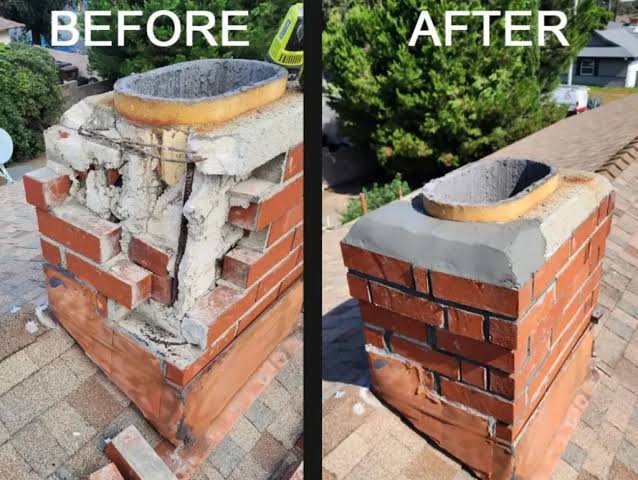
Sources: Angi, 2026, NFPA data via J.S. Held
Chimney repair in NJ almost always comes down to three recurring issues: cracked flue liners, damaged crowns, and loose or spalling bricks. Each one starts small and worsens with every freeze-thaw cycle New Jersey winters bring, which is why catching them early keeps repair costs on the low end of the range rather than the high end.
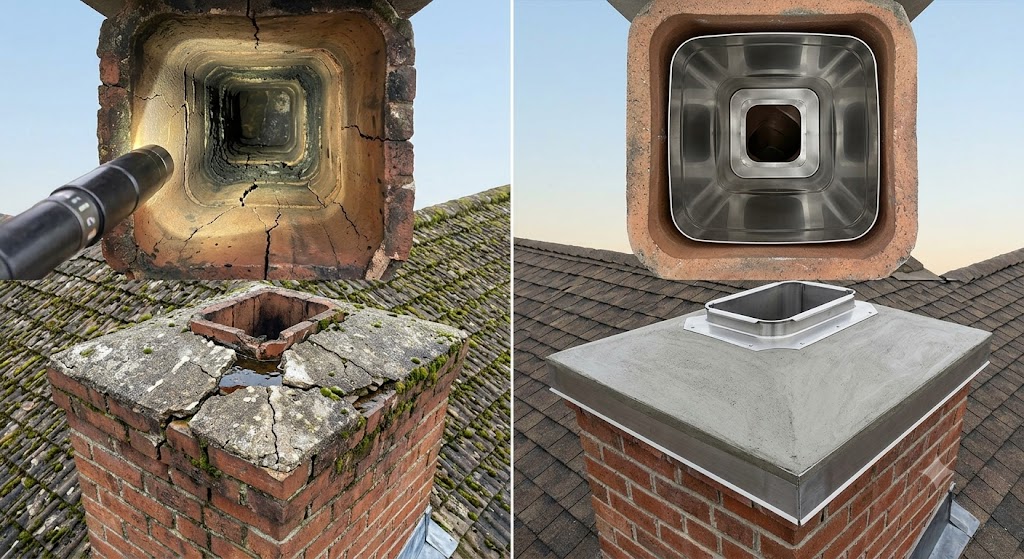
A cracked flue liner is the most safety-critical issue — it's the interior passage that carries smoke and combustion gases, including carbon monoxide, safely out of your home. Repairing cracked flue tiles typically costs $300–$1,000, but a full liner replacement runs $1,000–$5,000+ depending on chimney height and liner material. (RoofMedic, 2026)
The chimney crown — the concrete slab that caps the masonry below the flue — is your chimney's primary defense against water. Once it cracks, every rainstorm pushes moisture into the brick and mortar beneath it. Minor crown repairs cost $150–$700; full crown replacement runs $1,000–$3,000. (HomeGuide, 2026)
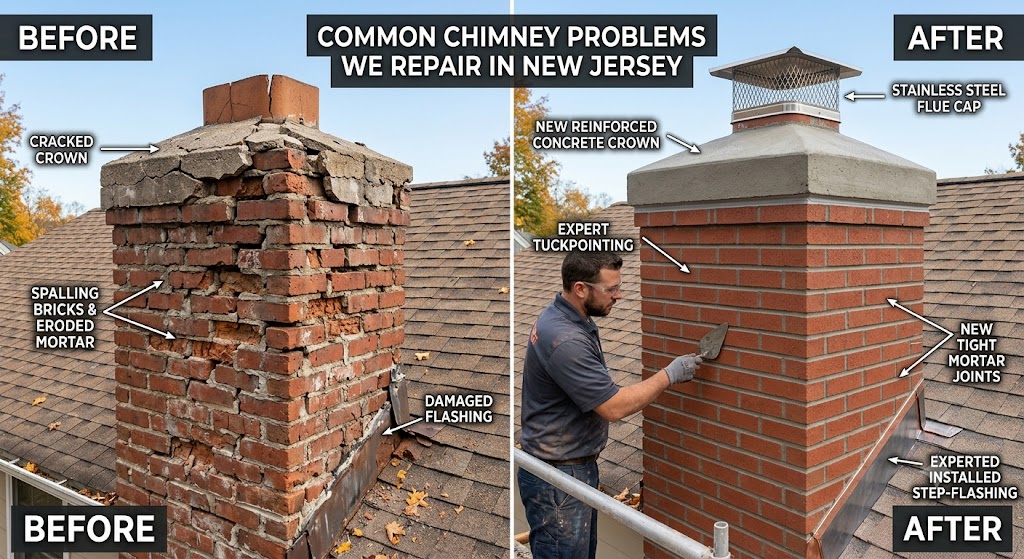
Loose and spalling bricks are usually the most visible sign something is wrong — but by the time bricks are visibly loose, water has typically been working through the mortar joints for one or more winters already. Repointing (replacing the mortar between bricks) costs $150–$500 for minor sections, up to $1,000–$3,500 for extensive brick replacement from the crown to the roofline. If you notice this on your home, a roof inspection that includes the chimney flashing is the right next step, since chimney and roof issues are often connected.
Key Point: The three problems above rarely occur in isolation — a cracked crown that goes unrepaired for a season often leads to brick spalling the following winter.
The reason chimney damage escalates so predictably in New Jersey comes down to one mechanism: freeze-thaw cycling. Water gets into a hairline crack, freezes overnight, expands roughly 9% in volume, and widens the crack. This repeats dozens of times each winter — which is why a $150 crack that's ignored in October can become a $1,500 crown replacement by spring.
Homeowners insurance often distinguishes between sudden damage (usually covered) and gradual deterioration from lack of maintenance (usually not covered) — another reason annual inspections matter for more than just safety.
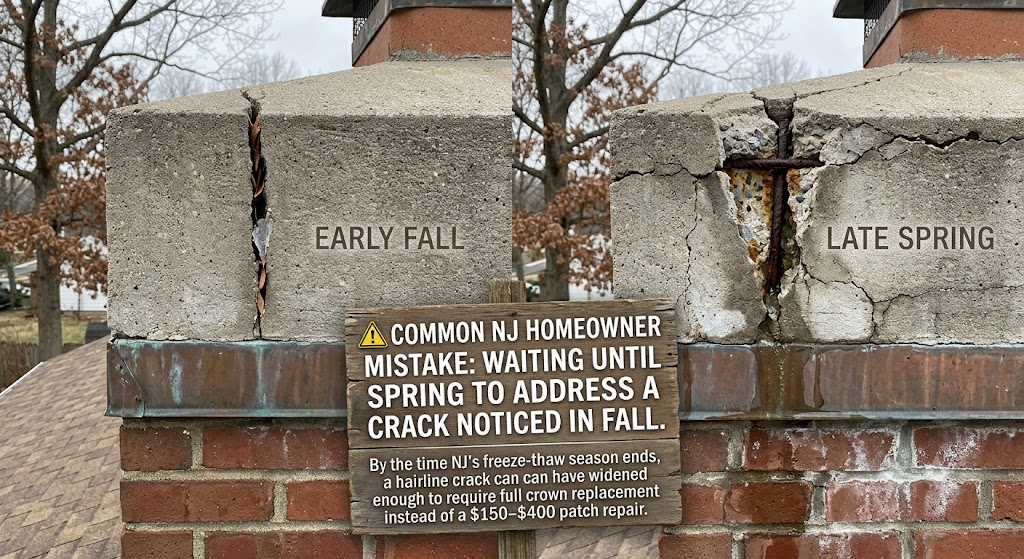
Waiting until spring to address a crack noticed in fall. By the time NJ's freeze-thaw season ends, a hairline crack can have widened enough to require full crown replacement instead of a $150–$400 patch repair.
The same logic applies to flue liners. A hairline crack that lets in trace moisture during one winter can develop into a full structural crack by the next, at which point the repair shifts from a same-day patch to a multi-day liner replacement. Getting ahead of it with a fall inspection — before heating season starts — is the single most cost-effective thing an NJ homeowner can do for their chimney.
Key Point: Schedule your chimney inspection in early fall, before you start using your fireplace or furnace for the season — not after you notice a problem.
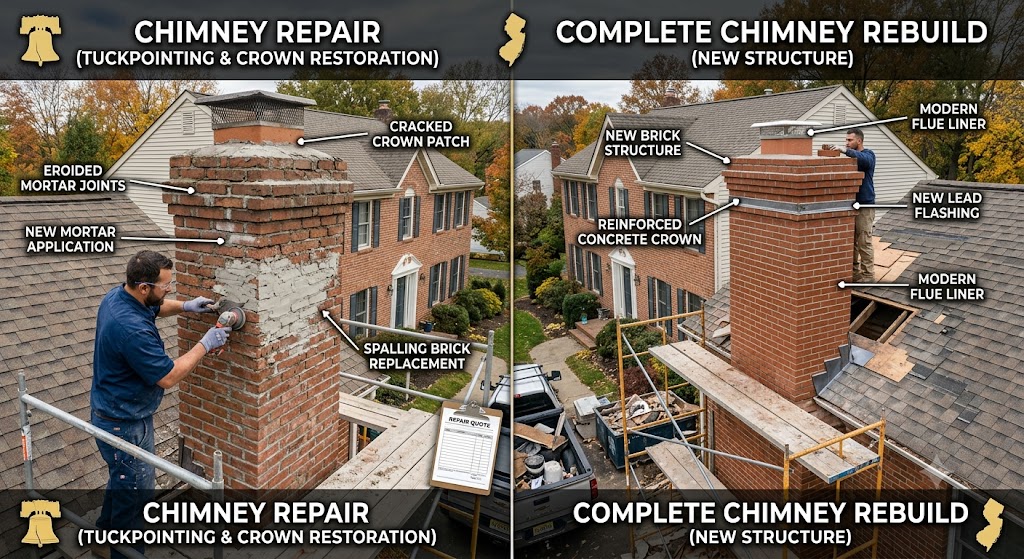
Not every chimney problem needs the same solution. Here's how NJ masons typically decide between a targeted repair, a partial rebuild, and a full replacement, based on where the damage sits and how far it's progressed.
| Factor | Repair | Partial Rebuild | Full Replacement |
|---|---|---|---|
| When it applies | Isolated cracks, minor crown or flashing damage | Top 3–5 ft damaged, leaning stack above roofline | Structural failure, leaning below roofline, unsafe |
| Typical cost | $200–$850 | $1,500–$3,500 | $4,000–$15,000 |
| Timeline | Same day to 2 days | 2–4 days | 1–2 weeks |
| Permit needed in NJ | Rarely | Sometimes | Usually |
Most chimney calls Perfect Roofing Team receives fall into the "repair" column — a cracked crown, a section of loose bricks, or a flashing leak. Full rebuilds become necessary when repairs have been deferred for multiple seasons, which is the scenario a free inspection is designed to prevent. (CostToRenovate, 2026)
Flue liner repair starts with a Level 2 camera inspection — a video scan of the full interior of the flue — to locate every crack, not just the ones visible from the top. Depending on findings, a mason will either seal isolated cracks with high-heat refractory mortar, or recommend a full stainless steel or clay tile relining if damage is extensive.
Crown repair follows a similar logic: minor cracks get sealed with a flexible waterproof crown coating, while crowns with structural cracking are removed and rebuilt with a properly sloped concrete pour that sheds water away from the flue instead of pooling against it — a common flaw in older, flat-poured crowns.
For flashing — the metal seal where the chimney meets the roofline — the fix depends on whether the original installation used step flashing or a continuous piece. Step flashing failures are usually isolated and repairable; continuous flashing that has pulled away from the masonry over years often needs full replacement to seal properly again.
Every repair Perfect Roofing Team performs starts with a written scope after inspection — so you know exactly what's being fixed, what material is used, and what the timeline looks like before any work begins.
If you've spotted a crack, staining, or loose bricks, here's the fastest path to getting it resolved safely and at the lowest possible cost.
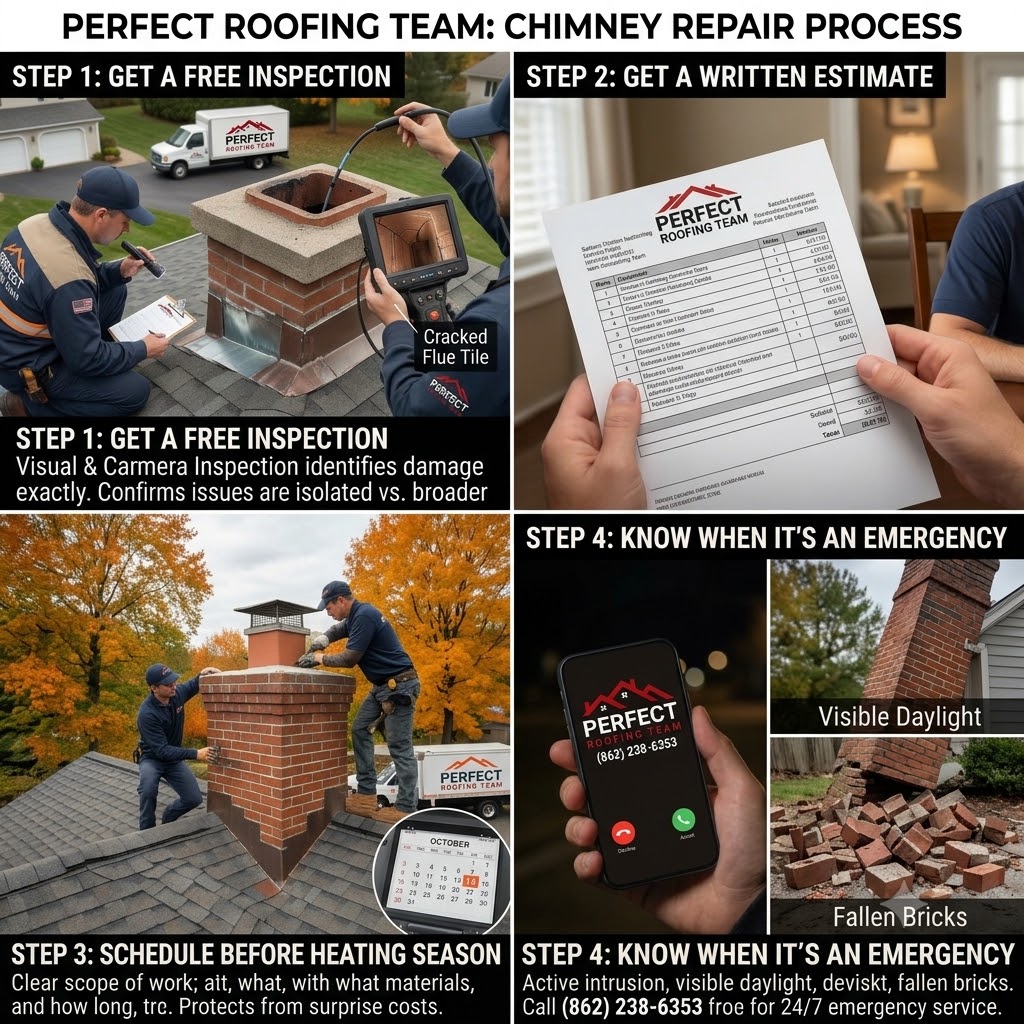
Step 1 — Get a free inspection. A visual and, where warranted, camera inspection identifies exactly what's damaged before you're quoted a price. This also confirms whether the issue is isolated or connected to a larger flashing or roofing problem.
Step 2 — Get a written estimate. A clear scope of work — what's being repaired, with what materials, over what timeline — protects you from surprise costs mid-job.
Step 3 — Schedule before heating season if possible. Fall repairs mean your chimney is sealed and safe before winter's freeze-thaw cycle can widen any existing cracks further. See our roof inspection service if you're unsure whether the issue starts at the chimney or the roofline.
Step 4 — Know when it's an emergency. Active water intrusion into your home, visible daylight through the flue, or bricks that have fallen are all reasons to call immediately rather than wait for a scheduled appointment. Perfect Roofing Team offers 24/7 emergency service at (862) 238-6353 for exactly these situations.
48,530 home heating fires per year — the national annual average between 2014–2018, with fireplaces and chimneys contributing to nearly half. (NFPA data via J.S. Held)
1 inspection per year, minimum — required by NFPA 211 for all chimneys, fireplaces, and vents, regardless of usage frequency. (NFPA 211)
$455 average repair cost — nationally, for common chimney fixes; range is $160–$750. (Angi, 2026)
$1,000–$5,000+ for flue liner replacement — once minor liner cracks progress to full replacement. (RoofMedic, 2026)
$1,000–$3,000 for full crown replacement — versus $150–$700 for early crown repair, illustrating the cost of delay. (HomeGuide, 2026)
$4,000–$15,000 for a full chimney rebuild — the outcome when repairs are deferred long enough to compromise the structure. (CostToRenovate, 2026)
Inspection: A mason examines the crown, flue, and mortar joints from the roof and, if needed, runs a camera scan of the flue interior to check for cracks not visible from outside.
Estimate: You receive a written scope covering exactly what will be repaired, the materials used, and the timeline — before any work begins.
Repair: Depending on findings, this typically means sealing or rebuilding the crown, repointing affected mortar joints, and sealing or relining cracked flue sections. Most single-story repairs are completed in one to two days.
This walkthrough describes a typical repair process and is not a specific client case; costs and timelines vary by chimney condition and accessibility.
From a single cracked brick to a full crown replacement, Perfect Roofing Team's licensed masons handle it — with a free inspection and a written estimate before any work starts.
→ Request a Free Chimney InspectionOr call us directly: (862) 238-6353 — Free inspection · 24/7 NJ service
Most common chimney repairs — cap replacement, minor crown repair, small mortar cracks — run between $200 and $850. Larger jobs like full crown replacement or flue liner replacement can range from $1,000 to $5,000+, depending on the extent of damage and chimney accessibility. Every Perfect Roofing Team inspection includes a written estimate before any work begins. (HomeGuide, 2026)
Address chimney damage as soon as you notice cracks, white staining on the exterior masonry (efflorescence), loose bricks, or water intrusion in your attic near the chimney. Left untreated, minor masonry damage can lead to structural failure and costly interior water damage. A roof inspection can catch related flashing issues at the same time.
Surface-level tasks like clearing debris from a cap are fine for homeowners. Flue liner repair, crown replacement, and structural masonry work require a licensed mason — chimneys involve fire and carbon monoxide risk, and many NJ municipalities require permits for structural chimney work. (NJ Division of Codes and Standards)
Freeze-thaw cycles are the leading cause of chimney masonry damage in New Jersey. Water enters small cracks, freezes, expands, and widens the crack — a process called spalling. Left unaddressed, this cycle repeats every winter and accelerates structural decay, turning a small patch job into a full crown or brick replacement.
Yes. A cracked flue liner can allow toxic combustion gases, including carbon monoxide, to leak into livable spaces. A cracked crown allows water into the chimney structure, which can freeze, expand, and eventually cause bricks to shift or fall — a safety hazard as well as a structural one.
New Jersey's freeze-thaw winters are especially hard on chimney masonry. Repeated freezing and thawing of trapped moisture is the single biggest driver of crown cracks and brick spalling, which is why an inspection before heating season — not after a problem appears — is the most cost-effective timing.
Coverage depends on the cause. Damage from a sudden event like a storm or lightning strike is typically covered. Gradual deterioration from age or lack of maintenance is usually not covered, which is why annual inspections matter for both safety and insurance claims. Check your specific policy for details. (Insurance Information Institute)
Call a licensed mason if you see cracks, leaning, loose bricks, water stains near the chimney, or if it has been more than a year since your last inspection. Perfect Roofing Team offers free inspections and 24/7 emergency service at (862) 238-6353 — request an appointment online.
✍️ Written & reviewed by Perfect Roofing Team
Perfect Roofing Team — Licensed & insured NJ roofing contractor serving all 21 counties. This page was written and structured by the Perfect Roofing Team to reflect real experience in roofing, storm damage, and emergency repair across New Jersey.
📍 380 Garibaldi Ave, Lodi, NJ 07644 · 📞 (862) 238-6353 · 🕑 Available 24/7/365 · 4+ years serving NJ homeowners & businesses
Last reviewed: July 2026